
Olive Skin Color Analysis: Why You Keep Getting Contradictory Results
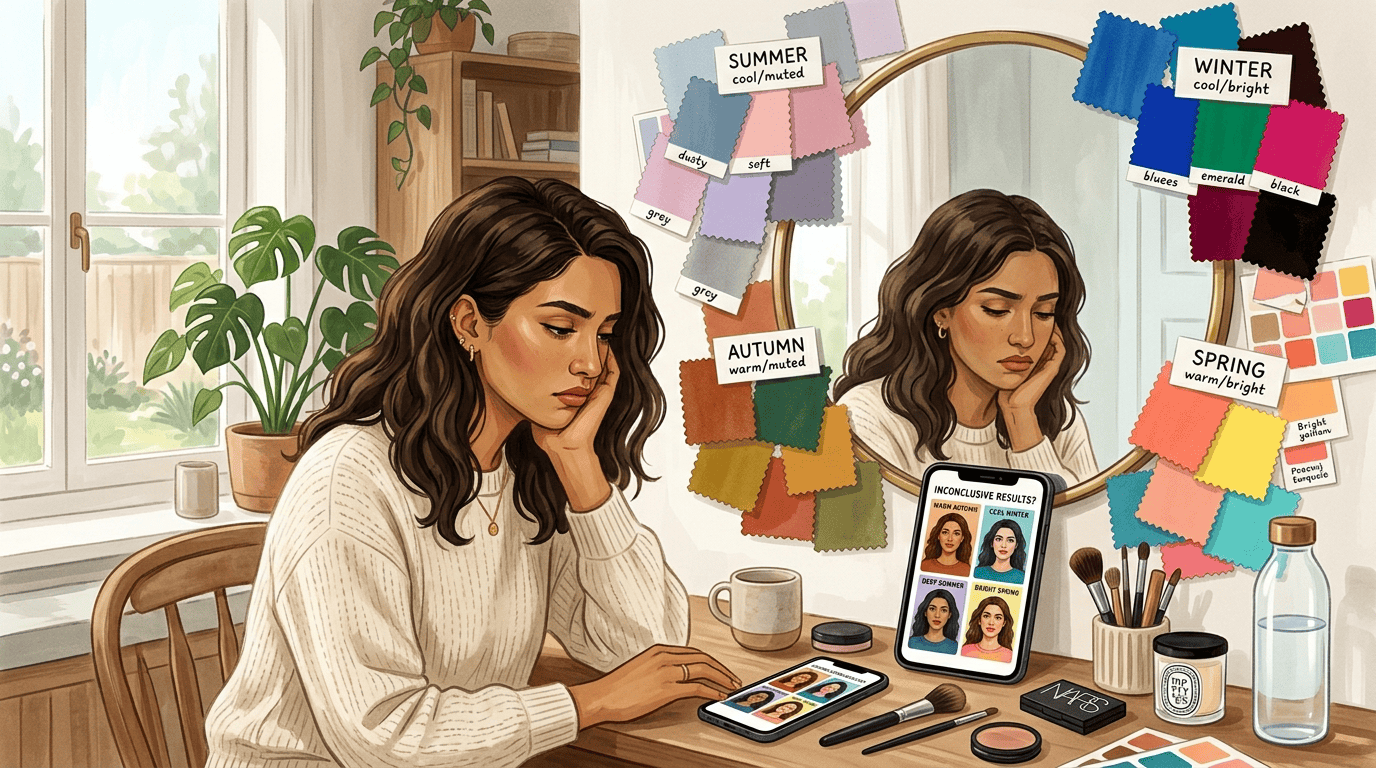
One week the internet says you are Soft Summer. The next week a consultant says Deep Autumn. Then someone else insists Bright Spring because your eyes light up in clear color, while another person swears black is too harsh and you must be Summer after all.
If you have an olive complexion, you have likely encountered being perceived as two completely opposite seasons.
And no, it does not automatically mean color analysis is nonsense.
It usually means the question has been oversimplified. Most color analysis advice is built around a clean warm-vs-cool decision. Olive skin is where that shortcut starts to break. What people call "olive" often carries a muted yellow, green-gray, or golden cast at the surface, while the face can also show visible redness, shadow, pigment variation, and hair contrast at the same time. Once those signals stack up, people stop judging one variable and start judging five at once.
That is why you can get Summer in one photo, Winter in another, and Deep Autumn from a pro draping session that still feels half-right.
The real problem is not just undertone
The science version is more interesting than the internet version.
Skin-imaging and perception studies do not treat facial color as a single "undertone" slider. They repeatedly model visible skin appearance through the interaction of pigments and light, especially melanin and hemoglobin. Research on facial coloration also shows that redness, yellowness, lightness, and color homogeneity all change how healthy, even, or attractive skin looks.
That matters because olive skin is often misread as one neat conclusion when it is really a combination of signals.
The useful way to think about olive skin is not "olive equals warm" or "olive equals neutral." It is closer to this: olive is a visible cast that changes how your skin reads. It can make warm shades look muddy, cool shades look chalky, and some otherwise ordinary colors suddenly look excellent because they balance the cast instead of exaggerating it.
If your skin seems warm in one situation and cool in another, that does not mean you are doing the test badly. It often means the test is too blunt for the problem.
Why olive people get typed into opposite seasons
Look at the patterns in color-analysis communities and the contradiction is surprisingly consistent.
This happens because different observers anchor on different cues.
Some people see surface yellowness first and vote warm. Some see mutedness and vote summer or autumn. Some react to eye brightness and vote bright season. Some react to dyed dark hair, strong brows, or black clothing and read the face as higher contrast than it really is.
None of those cues are completely irrational. They are just incomplete on their own.
Research on facial appearance makes this easier to understand. Skin color homogeneity changes perception. Hair color and skin color interact. Even subtle shifts in redness and yellowness change what viewers read as healthier or more balanced. In other words, the final impression is not coming from undertone alone. It is coming from undertone plus distribution plus contrast plus context.
That is a big reason professionals can disagree too.
A seasonal system that prioritizes temperature first may pull an olive client in one direction. A system that prioritizes chroma or value may land somewhere else. A strong analyst can still be working inside a framework that gives extra weight to the variable that is loudest on you, not necessarily the one that is most useful for wardrobe decisions.
Photos make the confusion worse
Phone-based color analysis is helpful. It is also one of the easiest ways to manufacture contradictory evidence.
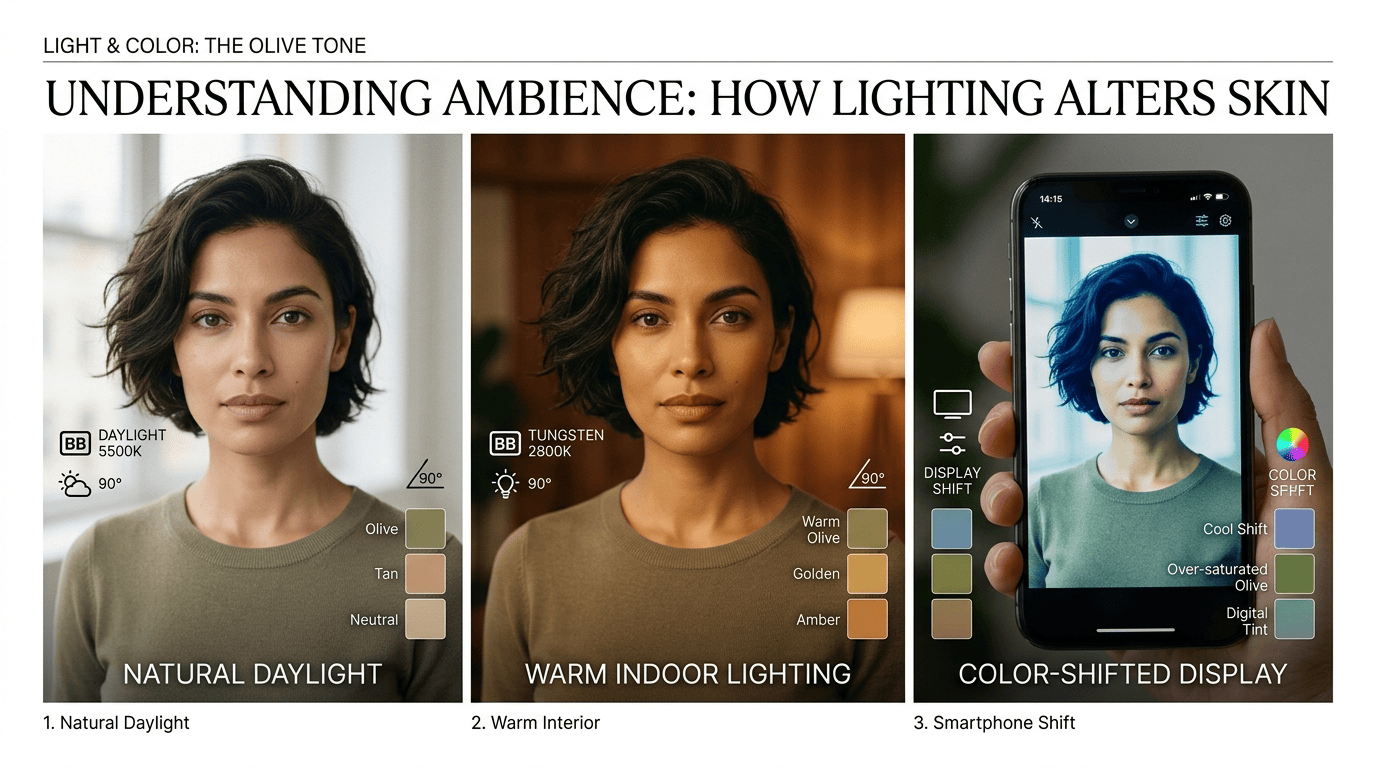
Medical photography research has shown that camera angle, distance, and white balance can materially shift captured color. More recent skin-tone imaging work also shows that illuminant choice matters, and that standard methods become less accurate when the lighting changes. Then your display adds another layer: Apple documents that True Tone adjusts color and intensity to match ambient light, and Night Shift warms the display on purpose.
So yes, the same face can honestly look cooler in one selfie and warmer in another, even before anyone starts debating your season.
If you have olive skin, that instability is more punishing because olive complexions already sit close to the edge where small shifts change the read.
Then add the usual real-world noise:
- dyed hair that changes apparent contrast
- tinted brows or lashes
- facial redness around the nose or cheeks
- heavy base makeup
- warm indoor bulbs
- auto-enhanced phone photos
- black tops used as a default "neutral"
By the time people in comments are telling you "you are obviously a Winter" or "definitely a Light Spring," they may be reacting to your hair choice, your camera pipeline, or your screen more than your skin.
The bigger mistake is comparing the wrong colors
A lot of olive typing goes wrong before the analysis even starts.
People compare cream versus optic white and call it temperature. Then they compare dusty rose versus neon orange and call it proof. Then they compare blonde hair versus black hair and call it season.
Those are not controlled comparisons. They are stack-overflow arguments for the face.
For olive skin, the better question is not "warm or cool?" in isolation. It is:
- What happens to my skin when temperature changes but depth stays similar?
- What happens when chroma changes but temperature stays similar?
- What happens when contrast changes but the actual skin read stays clean?
That framework sounds less glamorous than being crowned a season, but it is far more reliable.
In practice, many olive clients discover that their hardest decision is not temperature first. It is chroma first.
Muted olives often get mistyped as cool because softness helps the skin look more even. Clear olives often get mistyped as warm because brightness makes the face look more alive. Deep olives can get pushed into autumn by default even when cooler jewel tones are better. Lighter olives can get pushed into spring even when the palette is too cheerful and too yellow.
A more reliable way to analyze olive skin
First, do not let hair make the decision for you. Research on facial perception shows hair color and skin color interact. If your hair is dyed much darker, warmer, or lighter than your natural level, it can completely change how people read your contrast.
Second, stop using your "eye pop" as the only success metric. A color can make the eyes look brighter and the skin look worse at the same time. Good draping is about the whole face: skin clarity, shadow reduction, evenness, lip definition, and whether the face arrives before the color does.
Third, keep notes on complexion product failures. If warm base makeup keeps turning orange, that is evidence. If pink foundations keep going gray, that is evidence too. Olive skin often reveals itself less through abstract theory and more through a long trail of almost-right products.
What to do if you are still between two seasons
Stay there for a moment.
That middle ground is often more honest than forcing a dramatic answer too early.
If your best drapes keep clustering around one value range and one chroma level, but temperature is only slightly split, use that. Build from the pattern that is most stable. You can make excellent decisions with a working palette like "medium-depth, lower-chroma, neutral-cool" or "clear, warm-leaning, medium-high contrast" even before you pick the perfect seasonal label.
This is also where digital tools can be useful when they are used correctly. The goal is not to receive a magic identity in ten seconds. The goal is to compare like with like, keep the input conditions stable, and notice which families consistently clean up the face.
That is a much better use of online color analysis for olive skin: not a one-off verdict, but a controlled way to narrow the field before you spend money on hair, makeup, or a closet overhaul.
The bottom line
If you keep getting contradictory color analysis results, olive skin may not be the exception. It may be the case that reveals the weakness of simplified color typing.
Olive complexions are often hard to read because the face is broadcasting more than one message at once: pigment balance, surface cast, redness, contrast, chroma, and lighting response. Compress all of that into a warm-cool binary and the answer will keep wobbling.
The fix is not giving up on color analysis.
The fix is asking better questions.
Separate temperature from chroma. Separate skin from hair. Compare controlled drapes instead of random favorites. Trust repeated evidence more than one viral test.
Once you do that, the contradiction usually starts to look less like mystery and more like signal.