
In-Person vs. Online Color Analysis: Which One Is Right for You?
If your feed has recently been full of questions like "Am I a Cool Winter or a Warm Spring?", you have probably already noticed that color analysis is no longer a niche beauty topic. In a 2024 report, Axios noted that TikTok content tagged with #coloranalysis had already passed 321 million posts. Color analysis has clearly gone mainstream, and plenty of people now use it to figure out which colors actually suit them. So in 2026, if you want to do a serious color analysis, should you go in person or online?
First, think about what problem you are trying to solve
The first time most people encounter color analysis, they assume it is simply a test that tells you which season you belong to. In practice, though, the questions people really want answered usually look more like this:
- Why does this top always make me look tired?
- Would I suit a warm hair color better, or a cool one?
- Why does a color look bright and flattering on someone else, but make me look dull?
- Can I make shopping for clothes, lipstick, and accessories less hit-or-miss?
Once you look at it that way, in-person and online color analysis stop feeling like an either-or choice. They solve slightly different problems.
In-person analysis is better at showing you why certain colors work. Online analysis is better at giving you a practical starting point quickly, and many tools now use AI to help you try colors on right away so you can start using the results with less trial and error.
Why is in-person color analysis still taken more seriously?
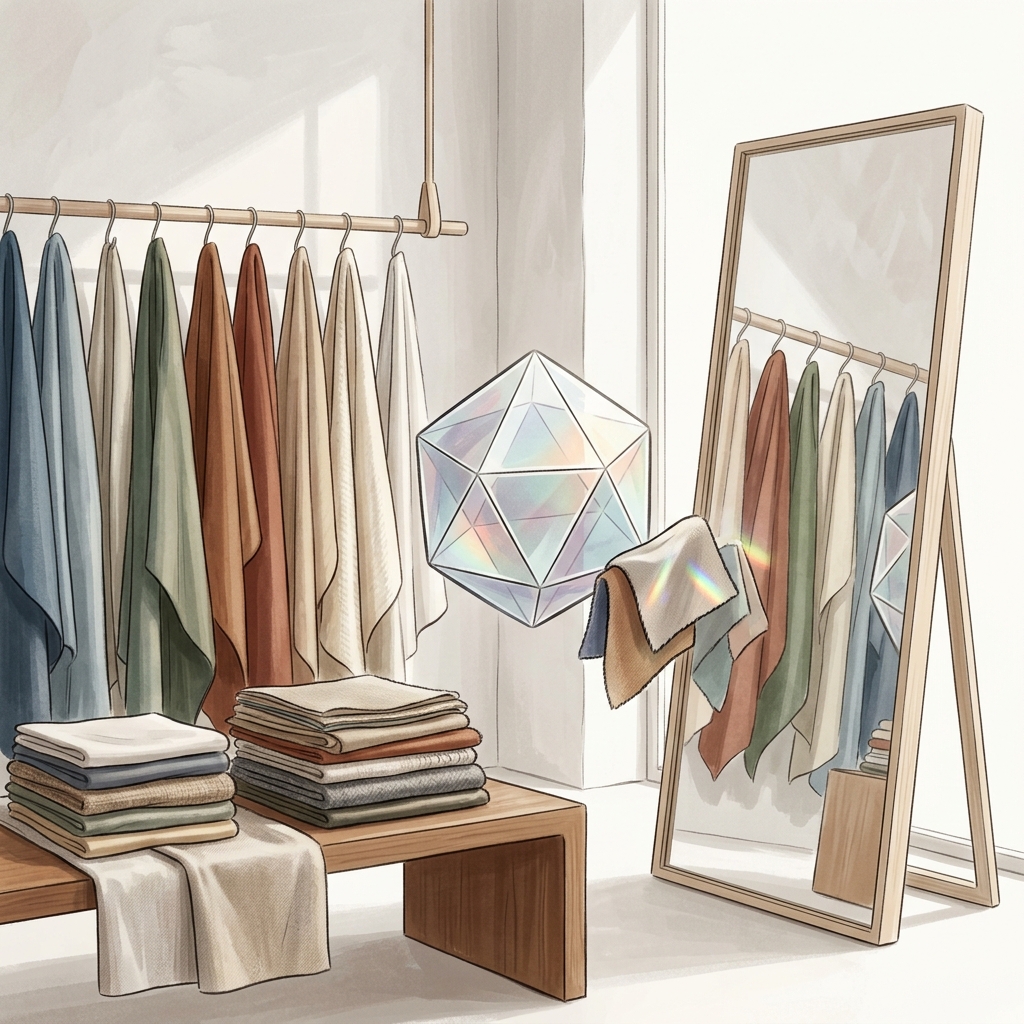
The biggest advantage of an in-person session is not the experience or the sense of occasion. It is control.
Based on public information from firms such as House of Colour, a professional in-person analysis usually asks clients to arrive with little or no makeup, avoid spray tans, and sit in natural daylight while the analyst performs draping, placing specially selected fabrics near the face again and again for comparison. The benefit is straightforward: the analyst sees how your coloring reacts to different hues in a relatively stable environment, rather than judging you through a photo that has already been filtered through a phone camera and a screen.
That makes it much easier to catch the details that are not always obvious in pictures. Do your under-eye shadows look heavier? Do fine lines become more noticeable? Does your skin look clearer and more even? Do your eyes stand out more? Many people leave an in-person consultation thinking, "I did not expect the difference to be this obvious," not because they were talked into it, but because they could actually see it in the mirror.
There is another reason in-person analysis feels more valuable: you come away with the reasoning, not just the label. Why does a cool blue flatter you more than a warm blue? Why do softer, lower-saturation shades make you look more refined? Why do certain high-contrast colors overpower you? Those explanations are usually much easier to understand when someone is guiding you through the process in real time. If it is your first color analysis, understanding the logic can matter even more than the final result itself.
Of course, in-person analysis also has clear downsides.
- It takes more time, planning, and travel. According to public descriptions from analysts and studios, a full consultation often runs two to three hours. For many people, that means blocking off half a day or even traveling to another city.
- The quality of the experience depends heavily on the person you book with. Reviews, before-and-after examples, and the analyst's method still matter a lot.
Why has online color analysis become so popular?
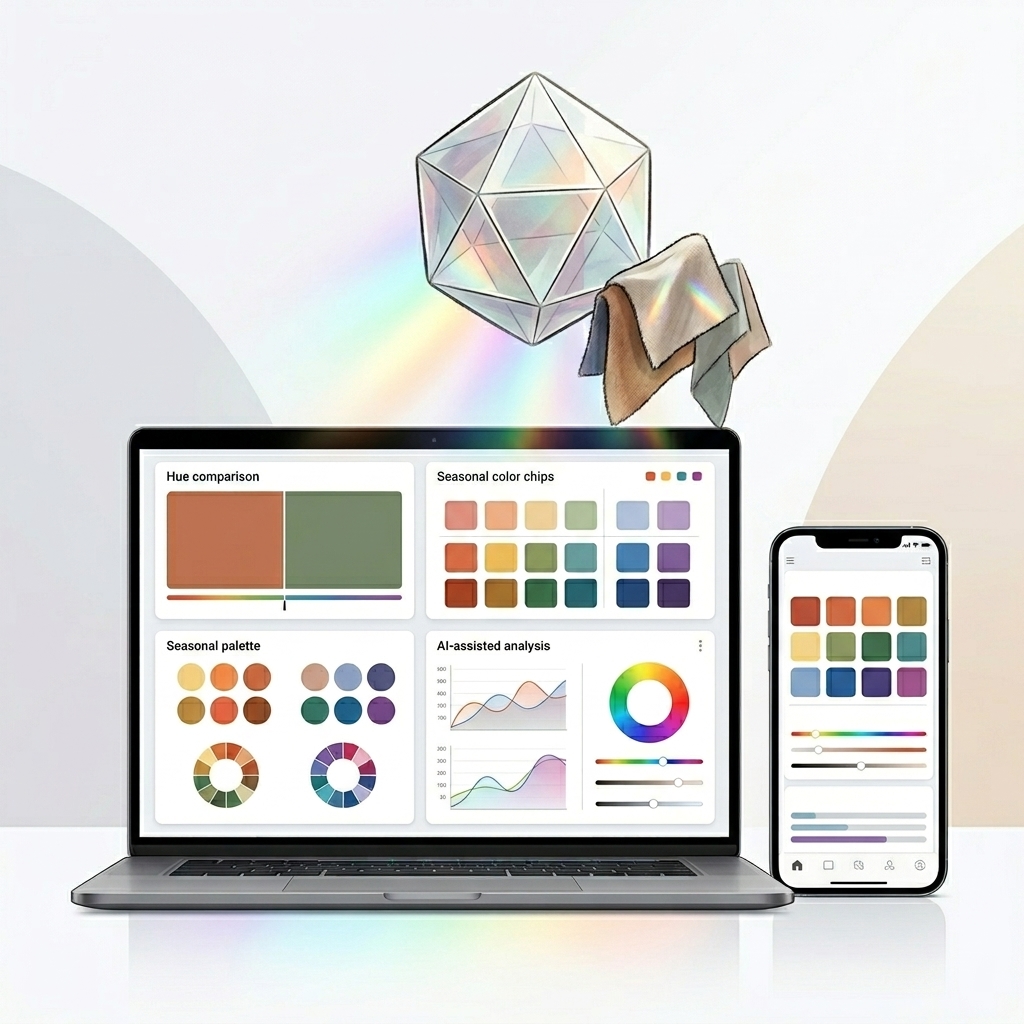
Because it fits the way most people already live and shop.
You take a photo, upload it, wait for the result, and save your digital palette on your phone. Later, when you are shopping for clothes, lipstick, or hair-color inspiration, you can pull it up instantly. That workflow is easy to understand and easy to use.
There is one common misunderstanding worth clearing up here: online does not automatically mean AI. Most online color analysis services fall into two broad categories.
- AI or algorithm-based tools that generate a season and palette from a selfie
- Remote human analysis, where a consultant reviews the photos you submit and gives you a result
The most obvious advantage of online analysis is accessibility.
- The barrier to entry is much lower. You do not need to leave home, and you are not limited by your city. Many services deliver results within 72 hours, and AI tools can return an answer in minutes. If you mainly want a solid first direction, online analysis is a very easy place to start.
- The second advantage is usability. Many online services give you a digital palette, color recommendations, and guidance for makeup, accessories, and styling. That is especially useful for online shopping because you can apply the result immediately rather than just learning that you might be one particular season.
- The third advantage is that online analysis works well as an everyday tool. Some AI apps turn color analysis, makeup try-ons, hair-color previews, and shopping filters into one continuous experience. For people who shop online often or need to make decisions quickly, that kind of speed is genuinely appealing.
The biggest limitation of online analysis is accuracy. It depends heavily on both the photo and the screen.
Many online services explicitly ask users to take pictures in natural light, avoid heavy makeup and filters, and sometimes wear white or hold up white paper as a color reference. They also warn against indoor yellow lighting, harsh direct sunlight, car interiors, and strong shadows. The instructions sound picky for a reason: as soon as the shooting conditions change, your skin tone, hair depth, and facial contrast can look different, which means the result can shift too.
And the photo is only the first variable. The screen is the second. Apple's own documentation notes that True Tone adjusts display color and brightness based on ambient light, while Night Shift pushes the display warmer overall. ICC guidance also makes the same broader point: if color accuracy matters, display calibration and viewing conditions matter too. In other words, the "same" color on your phone may not be the same color someone else sees on another device.
That is why online analysis can be extremely useful without necessarily being the most definitive answer. It is a high-efficiency tool, not automatically a high-certainty answer. That is especially true for AI-only tools. If changing your selfie changes your season, the result is probably better used as an informed starting point than as a final verdict.
So which one should you choose?
| Feature | In-person color analysis | Online color analysis | color-analysis.art |
|---|---|---|---|
| Assessment quality | Professional, analyst-dependent | Variable, photo-dependent | Feedback-optimized, photo check |
| Controlled live draping | ✅ | ❌ | ❌ |
| No travel required | ❌ | ✅ | ✅ |
| Digital palette you can revisit while shopping | Some analysts provide physical color cards | ✅ | ✅ |
| Built-in AI Studio quick try-on | ❌ | ❌ | ✅ |
| Built-in color swatch selection | ❌ | ❌ | ✅ |
| Good as a low-risk first step | ❌ | ✅ | ✅ |
| Price | $200-500 | From $25 | Completely free |
If this is your first color analysis and you want the most stable, persuasive answer possible, I would lean toward in-person first. That is especially true if you are about to do a major closet clean-out, rebuild your makeup routine, or change your hair color.
If convenience, speed, and budget matter more right now, or if there simply is not a trustworthy analyst where you live, online analysis is still well worth doing. Upload a clear photo with good lighting, use the AI result as a first pass, and then compare it with what you already know about your face, wardrobe, and how certain colors make you look.
If you want the most practical approach, the best answer usually is not choosing one over the other. It is combining them. Start online to get a strong sense of direction, then confirm it with a reliable in-person draping session before you make expensive changes to your wardrobe, makeup, or hair. That gives you the speed of online analysis and the confidence of in-person confirmation.
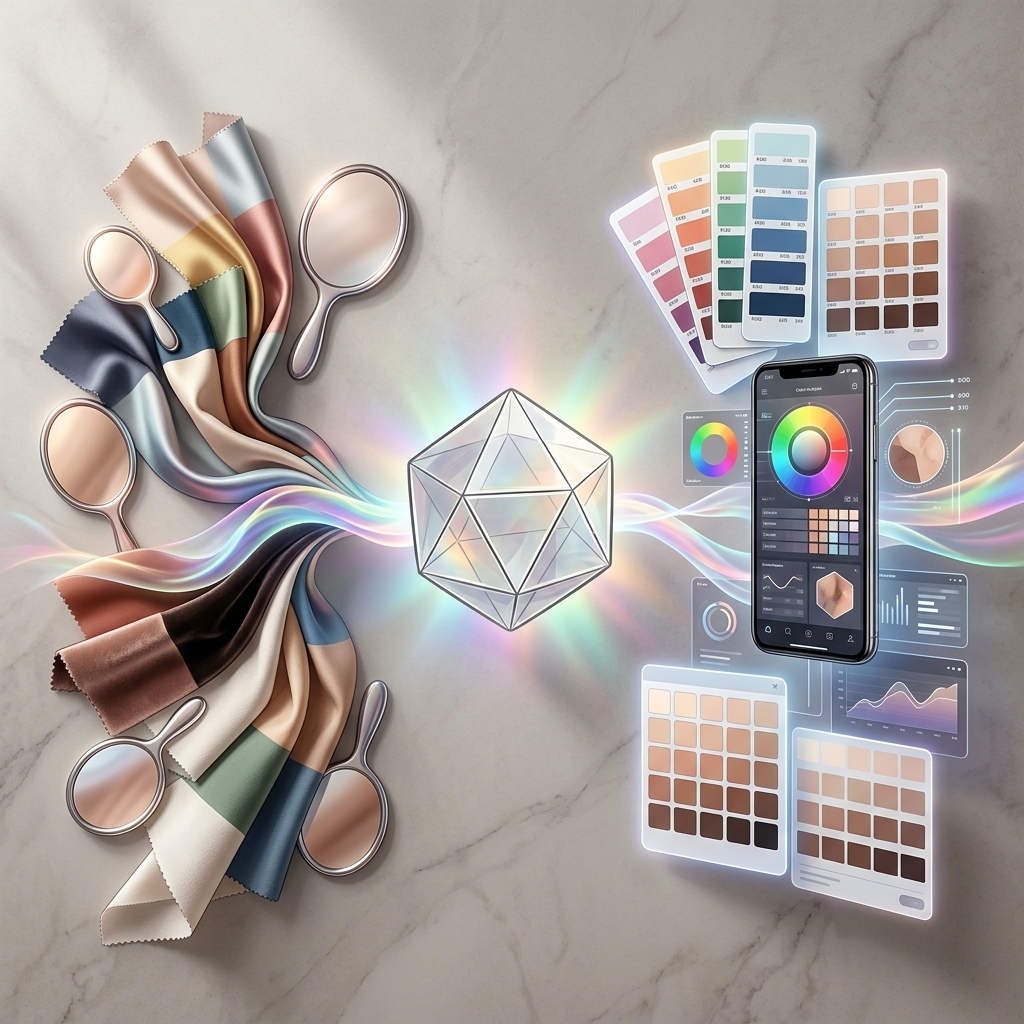
So the real difference between in-person and online color analysis is not that one is modern and the other is outdated. It is that one prioritizes controlled conditions and live observation, while the other prioritizes speed and accessibility.
If you want visible side-by-side changes, face-to-face explanation, and more confidence in the result, in-person analysis is probably the better fit. If you want a lower barrier to entry, faster feedback, and a digital tool you can carry around while shopping, online analysis may suit you better.
Whichever route you choose, try not to treat any single result as absolute truth. The real value of color analysis has never been the season label itself. It is the fact that it helps you find the colors that make you look healthier, shop with more confidence, and get dressed with less effort.